
What Charisma Actually Is — And Why High-Achieving Women Often Can’t Access It
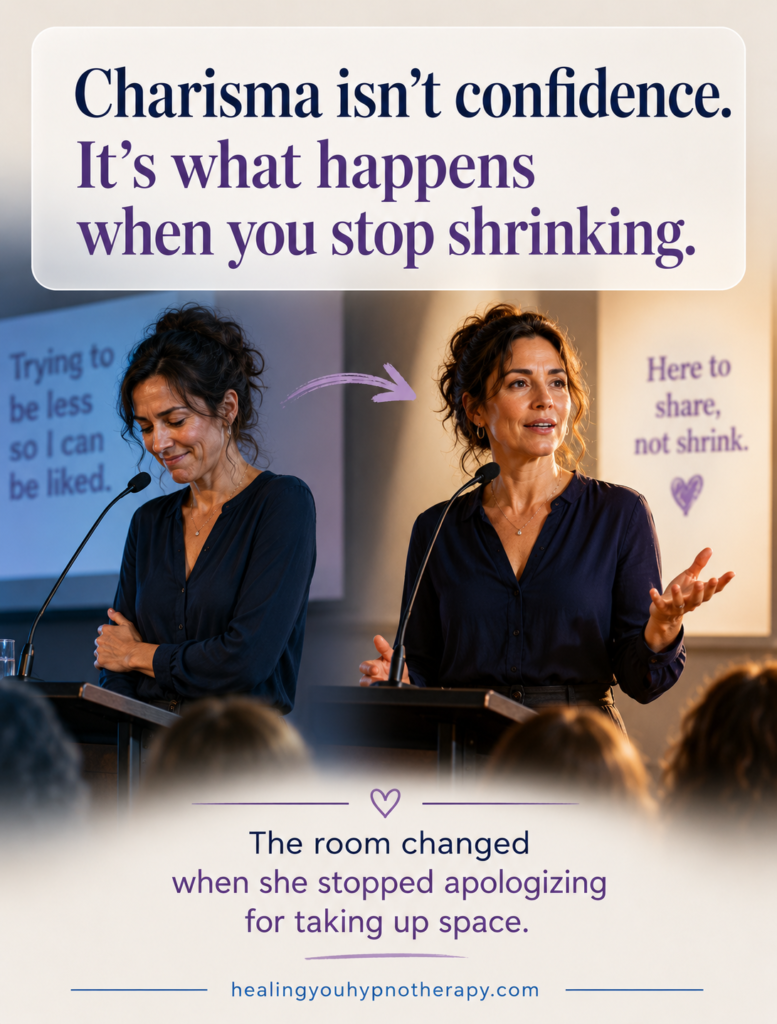
I used to walk onto a stage and immediately make myself smaller.
Not in a way anyone in the audience would notice. I was good at it — years of practice. The half-step back from the mic. The laugh that came a beat too soon. The softening of a line I’d rehearsed, decided in the moment was too much, and delivered at about 70% of the strength it deserved.
I’d been speaking for years before I understood what I was doing.
The Moment I Stopped and Invited My Authentic Self
Mid-presentation. Room full of people. I got to a line I’d said a hundred times — and something shifted.
I let it land at full strength. Didn’t pull back. Didn’t rush past it like I was apologizing for it. Just let it stand there.
The room responded differently than it ever had before.
Not because the words were different. The words were identical. Because the person delivering them had finally stopped pretending to be slightly less than she was.
That was the day I understood what charisma actually is.
What Being Charismatic Is Not
Charisma is not a personality type; in self-help it’s often treated that way, but in Weber’s meaning it is a form of authority attributed to an individual seen as exceptional, with unusual qualities or even powers. It’s not extroversion, or confidence, and it isn’t simply a charismatic style some people are born with and others aren’t.
It’s not polish, either. Some of the most magnetic speakers I’ve encountered are rough around the edges. What they have isn’t technique. It’s presence.
In Weber’s work, this idea became popular in social and leadership discussions beyond religion, where it was also tied to how followers grant power.
What Charisma Actually Is in Leadership
Charisma is what happens when the gap closes between who you’re performing and who you actually are.
The quality people respond to — the thing that makes someone magnetic, compelling, memorable — is not that they’ve mastered presentation skills. It’s that they’ve stopped holding back, and that others can make sense of them as both warm and capable.
It’s permission. Specifically, the permission you give yourself — out loud, in the room, in real time — to stop pretending to be less.
When that permission is present, the nervous system relaxes. The voice drops into its natural register. Eye contact holds a beat longer. The pauses don’t get rushed. High charisma often reads as emotional warmth, intense focus, and social confidence. In public speaking, nonverbal signals strongly shape how people rate credibility and intelligence, and posture, gestures, and vocal patterns can each be a sign of that presence to a surprising degree. The full weight of what you’re saying is actually felt — by you first, then by the room.
That’s what people are responding to. Not a performance. An absence of performance.
Why High-Achieving Women Struggle With This Specifically: Lessons from Barack Obama
Most high-achieving women have spent years — decades — learning to calibrate. To be confident, but not too confident. Assertive, but not threatening. Visible, but not too visible. Real presence does not come from dominating a room; charismatic people often use it to draw other people out instead.
The calibration becomes automatic. Subconscious. A threat response that fires before conscious thought has a chance to intervene. That over-management can make hard conversations feel harder, even when you have the ability to stay grounded, read emotion, and take empathetic action.
This is why coaching, speaking training, and practice only go so far. Active listening means listening to understand, focusing fully on the speaker without interrupting or mentally preparing a reply. You can rehearse the confident version all you want. But if the subconscious mind still believes that taking up full space is risky, it will quietly pull you back every time — a half-step, a softened line, a laugh that came a beat too early.
The gap doesn’t close through practice.
It closes when the belief underneath it changes.
What Changes When the Belief Changes
When a woman works with me around visibility, speaking, and the automatic pull to make herself smaller — the shift that happens isn’t behavioral. It’s subconscious, and modalities like hypnotherapy that safely access the subconscious mind allow us to work directly at the level where those patterns were formed.
The nervous system gets the message, at the level where it was first formed, that full presence is safe. That being seen clearly — fully, without the cushioning — is not dangerous. Her voice often starts to sound warmer and less guarded too, with a kind of softening that feels like a vocal hug.
And then something remarkable happens.
She stops managing herself so hard. What shows up instead is more genuine emotional expressiveness through body language, and it often reads as more positive and lightly playful rather than overcontrolled.
The space between who she’s been performing and who she actually is starts to close. And what comes through in that closing isn’t just confidence — it’s charisma. The magnetic, unmistakable quality of someone who has finally given themselves permission to be entirely present. In leadership, that presence also helps a leader rally followers around a shared vision or goal.
That’s not a technique. That’s a nervous system shift.
What Would Change for You?
If you’ve ever felt the pull to soften, qualify, or pull back at the exact moment you could have let something land fully — you know the gap I’m describing.
You don’t have to keep managing it. It can change.
Older religious uses in the bible framed charisma as divinely given grace or favor, with the Hebrew Bible and Christian Bible using hen and hanan to describe how god confers it. In 1 Corinthians, Paul says the holy spirit bestows charismata—the gift of God’s grace—within the church, and the gospels even portray Jesus as radiant with light at his baptism and transfiguration.
I’d love to invite you to a complimentary Stop Playing Small Strategy Session — a real session that includes a custom guided hypnosis experience. You leave already feeling different, and this free 45-minute hypnotherapy session for ambitious women is designed to help you experience that shift.
Book your session here → You can explore contact options for Healing You Hypnotherapy in San Diego or learn more about hypnotherapy and growth coaching for authentic confidence and goals before you decide.