
She had an Oscar. A production company worth nearly a billion dollars. A career most people would call a dream.
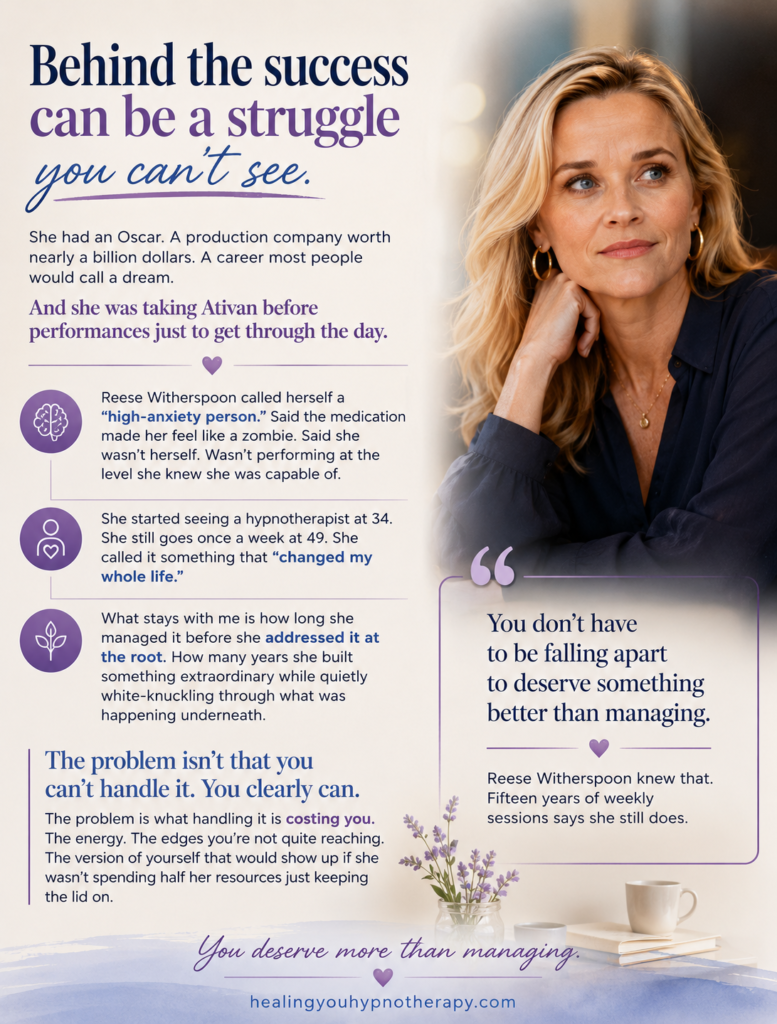
And she was taking Ativan before performances just to get through the day.
Reese Witherspoon talked about this publicly not long ago. She described herself as a “high-anxiety person” who used medication just to function through the things she was supposed to be good at. It made her feel like a zombie. She wasn’t performing at the level she knew she was capable of. She wasn’t even funny, she said, and funny is part of how she earns a living.
She started working with a hypnotherapist at 34. She still goes once a week at 49. She called it something that “changed my whole life.”
I’ve thought about her story often since I heard it. Not because it surprises me that a high-achieving woman carries anxiety. That part I see in my office every single week.
What stays with me is how long she managed it before she addressed it at the root.
What High Functioning Anxiety in Women Actually Looks Like
There’s a version of anxiety that looks like falling apart, and then there’s the version most high achievers live with.
High-functioning anxiety looks like success.. Many women internalize distress and keep it hidden behind competence. It can come with outward success and a calm outward appearance while hiding real internal struggles.
It’s the performance review you prepared for six times when twice would have been enough. The 2am mental replay of a conversation that went fine. It can also feel like ongoing anxiety in daily life even when other people don’t see it. The way you drive home and can’t quite remember driving. The physical tightness across your chest that you’ve learned to breathe through because there’s no other option, and also because you’re good at it by now.
High-functioning anxiety doesn’t mean you’re failing. It means you’ve adapted so well to the pressure that nobody would guess it’s there, including sometimes you.
The problem isn’t that you can’t handle it. You clearly can.
The problem is what handling it is costing you.
The Real Cost of High Functioning Anxiety Nobody Talks About
It shows up in the edges.
The idea you didn’t pitch because the timing felt wrong. The boundary you almost set but softened at the last second because fear of being perceived as incompetent made holding it harder. The version of you in that meeting who had something sharper to say and didn’t quite get there.
The exhaustion that doesn’t make sense on paper, because you slept, you exercised, you did everything right. High expectations, self criticism, and constantly second guessing can carry an emotional toll even when those habits are praised.
That’s not laziness. That’s what happens when your nervous system is spending a significant portion of its resources just keeping the lid on.
Reese Witherspoon described it as not being fully herself. Not operating at the level she was capable of. She had the career. She had the accolades. She just didn’t have full access to herself. That is why women with successful careers can still wrestle with self doubt and negative thoughts underneath the surface.
That’s a subtle thing, and it’s also enormous. That’s the hidden tax of high-functioning anxiety.
Why Traditional Approaches Often Don’t Get to the Root
Talk therapy works. Medication works for many people. Breathing exercises, journaling, reframing, all genuinely useful.
And yet.
Most high-achieving women who come to me have already tried some version of those things. For many, the pattern is shaped by societal pressures, gender roles, relationship issues, and job-related stress that create a sense of constant pressure beneath the surface, and many eventually start exploring alternative mental health services in San Diego that are designed for busy, high-performing professionals. They understand their anxiety intellectually. They can trace it back to childhood, to a pattern, to a particular season of their life, and identifying root causes helps, but it is not always enough to change the pattern on its own. They just can’t seem to change it from that understanding alone.
That’s not a failure of effort. High-functioning anxiety is not a formal clinical diagnosis in the diagnostic and statistical manual or statistical manual, and it is often discussed in relation to generalized anxiety disorder, one of several anxiety disorders tied to generalized anxiety patterns.
The part of your brain that generates the anxious response, the tightness, the hypervigilance, the bracing, is not the conscious, reasoning part. Understanding it consciously doesn’t automatically update it.
Hypnotherapy works at the subconscious level, where the pattern is actually stored. It’s not about relaxation, though the nervous system does settle. It’s about accessing the programming itself and beginning to change what’s written there, and understanding how hypnosis works for anxiety at a scientific level can make this process feel more grounded and accessible.
That’s what Reese Witherspoon found. That’s what I watch happen in sessions every week, and it’s the same kind of transformation described in more detail when you explore how hypnotherapy works to shift subconscious patterns.
If you want to understand more about how this works, anxiety therapy in San Diego is a good place to start, or you can read more about hypnotherapy for professional women and what to expect in a session.
You Don’t Have to Be Falling Apart to Deserve Better Than Managing
This is the part I want you to hear most.
There’s a belief, often unspoken, that you have to hit a wall before you’re allowed to get help. That as long as you’re functioning, you’re fine. That other people have it worse, so you should be grateful and keep going. But functioning can get mislabeled as normal stress, and that confusion often delays the moment women seek professional or accept professional help.
But “functioning” is not the ceiling. It’s the floor. Managing high functioning anxiety may include healthy boundaries and cognitive reframing.
You’re not looking for permission to fall apart. You’re looking for the version of you that isn’t spending half her energy just holding things steady.
That version exists. She’s not somewhere in the future, waiting for you to finally be healed enough to arrive. She’s underneath the managing. The work is just clearing the path to her.
Along the way, self care, sleep, nutrition, exercise, and support from peers can relieve anxiety and rebuild self esteem while deeper work is underway.
Reese Witherspoon started that work at 34 and still does it at 49, once a week. Not because she’s broken. Because she found something that gave her full access to herself, and she didn’t want to stop—much like clients who resonate with the approach of Jennifer, a board-certified hypnotherapist in San Diego, and choose to keep going because of how different they feel.
Frequently Asked Questions
Does hypnotherapy actually help with high-functioning anxiety?
Yes. Research supports hypnotherapy as an effective tool for high-functioning anxiety, particularly for the automatic, subconscious responses that don’t shift with conscious effort alone. Over 40 million adults experience anxiety disorders in the U.S., and women are more than twice as likely to face these mental health concerns. Even when someone appears capable on the outside, high-functioning anxiety symptoms can still persist beneath the surface. Many clients notice significant changes within a few sessions.
What are Causes of High-Functioning Anxiety in women?
Answer:
Women are socialized from an early age to manage emotional labor, anticipate others’ needs, and keep things running smoothly, often at the expense of their own inner world. The result? High-functioning anxiety that gets channeled into productivity, people-pleasing, and relentless competence rather than recognized as distress. Societal pressures, gender roles, relationship dynamics, and job-related stress all contribute to a sense of constant pressure beneath the surface. It looks like capability from the outside. It feels like exhaustion on the inside.
How Prevalent is High Functioning Anxiety?
High-functioning anxiety is tricky to spot, partly because the behaviors it drives look like virtues. The overachiever who never misses a deadline. The woman who somehow holds everything together while quietly white-knuckling her way through the day. Society doesn’t just tolerate these patterns, it rewards them.
Which makes it easy to miss how common the struggle actually is. Approximately 19% of adults experience symptoms of anxiety disorders, and that number almost certainly understates the reality. One reason: receiving an anxiety disorder diagnosis requires that symptoms interfere with daily functioning. But high-functioning anxiety, by definition, doesn’t look like interference. It looks like excellence. Many women who would qualify for an anxiety disorder diagnosis never receive one because they’re too good at managing the symptoms from the outside. The fact remains: 1 in 3 women will experience anxiety in their lifetime.
What does high-functioning anxiety feel like physically?
High-functioning anxiety doesn’t stay in your head. It lives in your body. Common physical signs include persistent muscle tension in the neck, shoulders, or jaw, disrupted sleep, difficulty fully relaxing even when nothing is actively wrong, and a low-level hum of restlessness that never quite settles. Some women also experience digestive issues, tension headaches, or fatigue that doesn’t improve with rest. Chronic stress from high-functioning anxiety can affect overall health and well-being over time, even when someone still appears to be coping well.
Is high-functioning anxiety a real diagnosis?
High-functioning anxiety is not a formal clinical diagnosis in the DSM, but that doesn’t make it any less real. It overlaps most closely with generalized anxiety disorder, which is characterized by persistent, excessive worry that’s difficult to control and shows up across multiple areas of life. The difference is that women with high-functioning anxiety often don’t look anxious from the outside. They look capable, organized, and on top of everything. Generalized anxiety disorder can absolutely be present even when someone is high-achieving and appears to be managing well. The absence of a formal “high-functioning anxiety” label is actually part of why so many women go unrecognized and untreated. They’re functioning well enough that nobody flags it, including sometimes themselves.
Is hypnotherapy safe if I’m already on medication?
Hypnotherapy is non-invasive and works alongside medical treatment, not in place of it. Healing You Hypnotherapy offers a holistic, root-cause approach that can complement your existing care. High-functioning anxiety can also show up as physical symptoms like muscle tension, persistent muscle tension, disrupted sleep patterns, and insomnia, and many women experience persistent muscle tension or even experience persistent muscle tension in the neck, shoulders, or jaw. Ongoing anxiety can also affect well being and contribute to chronic stress-related health issues, even when someone still seems to be coping well. Always keep your prescribing doctor informed about any complementary approaches you’re exploring.
What if I’ve tried therapy and it didn’t fully work?
Therapy and hypnotherapy work differently. If talk therapy helped you understand your anxiety but didn’t change how it feels in your body, that’s actually a common experience, especially when it shows up as excessive worrying, overthinking, and difficulty relaxing even with insight, which is why some women turn to clinical hypnotherapy as a counseling alternative when they want deeper, faster change. Breathwork techniques like deep breathing can support the nervous system between sessions during high-stress moments, though they may not fully resolve the stored pattern on their own, especially when confidence has taken a hit and you’d benefit from targeted support like confidence-building hypnotherapy in San Diego. Hypnotherapy addresses the pattern at the level where it’s stored, which is often where the shift happens.
How is a hypnotherapy session different from meditation?
Meditation is a practice you build over time to create a calmer baseline. Hypnotherapy is a targeted therapeutic session aimed at changing a specific pattern, and many women seek out local mental health-focused hypnotherapy services in San Diego when they’re ready to address that pattern more directly. Both have value. Meditation can support present-moment awareness and help regulate the nervous system day to day. But women with high-functioning anxiety often still need targeted help for the deeper patterns driving overworking, overthinking, and hypervigilance. Meditation can quiet the noise. Hypnotherapy works on what’s generating it, and practices like Healing You Hypnotherapy in San Diego are specifically structured around that kind of focused change.
Can high-functioning anxiety get worse over time if left unaddressed?
Yes. High-functioning anxiety tends to escalate under increased pressure, major life transitions, or sustained stress. What feels manageable at 35 can become harder to sustain at 45. The coping strategies that worked earlier, overachieving, staying busy, pushing through, eventually have diminishing returns. Addressing high-functioning anxiety before it reaches a breaking point is almost always easier than addressing it after.
How many sessions does it take to see results with high-functioning anxiety?
It varies depending on the depth and history of the pattern, but many clients notice meaningful shifts within two to four sessions. High-functioning anxiety that has been running for years can take longer to fully rewire, but most people leave even their first session feeling noticeably different, similar to how structured programs like results-oriented hypnotherapy for lasting behavior change emphasize early, noticeable shifts. The goal isn’t indefinite treatment. It’s real, lasting change at the root.
If this resonates, the next step is a Stop Playing Small Strategy Session. It’s not a consultation. It’s a real session, with custom guided hypnosis included. Practical coping strategies, like setting clear endpoints for daily tasks, can reduce unnecessary stress. You don’t just leave with a plan. You leave already feeling different.