
You Don’t Have to Have It Together to Keep Going
By Jennifer Dettloff-Carter, CCHt | Healing You Hypnotherapy
I have a confession.
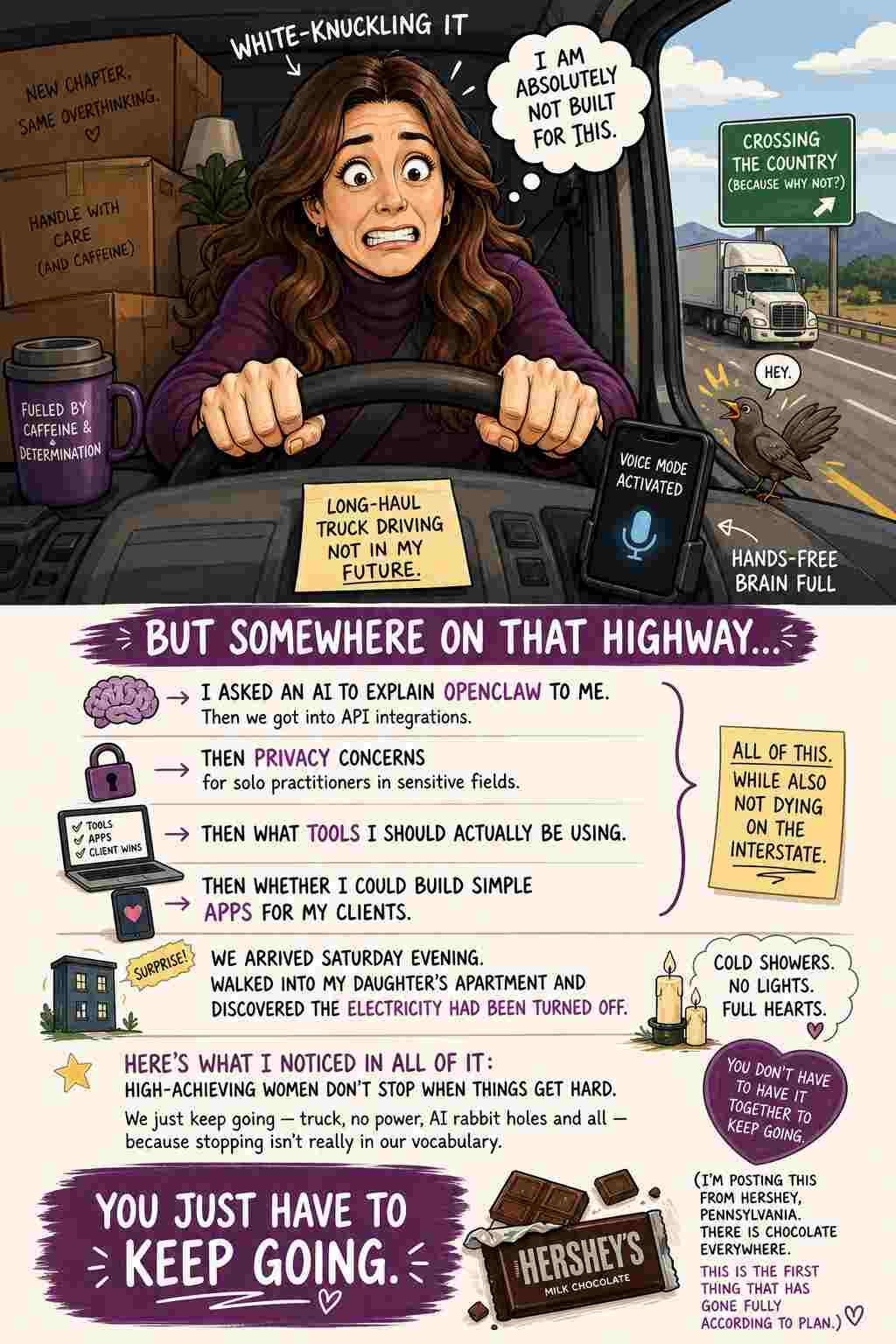
I’m a hypnotherapist who helps shut down anxiety in high-achieving women by helping them to get out of their own way. And a couple of days ago, I was white-knuckling a giant moving truck across the country — navigating potholes, passing semis, and at least one bird that chirped at exactly the wrong moment.
Long-haul truck driving is not in my future. That much is clear.
But somewhere on that highway — hands-free, voice mode activated — I was deep in a conversation with an AI about API integrations, privacy concerns for solo practitioners in sensitive fields, and whether I could build simple apps for my clients.
All of this. While also not dying on the interstate.
Table of Contents
What High-Achieving Women Actually Look Like Under Pressure
Here’s the thing about ambitious women and high achievers: we don’t stop when things get hard, and while we may be perceived as successful on the outside, we often struggle internally with anxiety that goes unnoticed.
We just keep going — moving truck, no power, AI rabbit holes and all — because societal expectations and cultural expectations drive us to persevere, even when it feels overwhelming. Stopping isn’t really in our vocabulary.
My daughter is starting PA school. We arrived Saturday evening, exhausted and proud and a little emotional. We walked into her apartment and discovered the electricity had been turned off. She hadn’t known she needed to set it up in advance. Every previous landlord had left it on. She’s lived independently for years. Nobody tells you what nobody told them.
So: cold showers. No lights. Full hearts. Like many women, she is already learning to juggle multiple roles and face high expectations from herself and society, a reality that contributes to chronic stress and anxiety.
And me, posting about OpenClaw from Hershey, Pennsylvania — where there is chocolate everywhere and this was the first thing that had gone fully according to plan. For women with high-functioning anxiety, the constant need to be productive and meet every demand can mask the true extent of their anxiety, as outward success often conceals significant stress, mental exhaustion, and even imposter syndrome.
Why “Keeping Going” Can Become Its Own Problem
The Superpower of High Functioning Anxiety That Runs on Empty
Anxiety in high achieving women often looks nothing like anxiety from the outside.
It looks like capability. Competence. The woman who handles everything — the move, the logistics, the daughter’s first night in a dark apartment, the business she’s building while all of it is happening.
What’s invisible is the cost. The nervous system that never fully lands. The body that keeps going because stopping feels more dangerous than the overwhelm itself. Internally, an active inner critic can fuel persistent self-doubt and decreased self-esteem, even as outward success is maintained.
Research on psychological resilience shows that the ability to push through adversity is genuinely valuable — and also that chronic activation without recovery has real consequences. Resilience isn’t the same as invincibility.
The women I work with are some of the most capable people I’ve ever met. They’ve built careers, raised families, survived hard things, and kept showing up. The challenge isn’t that they can’t handle pressure. Many also experience overlapping symptoms of anxiety disorders, including generalized anxiety and social anxiety, which can impact both personal and professional relationships. While high-functioning anxiety is not an official diagnosis or clinical diagnosis recognized in the DSM-5, it shares features with diagnosable conditions like generalized anxiety disorder.
It’s that their nervous system has gotten so good at staying in drive that it’s forgotten how to find neutral. A deeper understanding of high-functioning anxiety reveals that it can be caused by a combination of biological, psychological, and social influences, including genetic predisposition and family history of anxiety disorders. Anxiety in high-achieving women is frequently rooted in internalized personality traits and intense external pressures. Social conditioning teaches girls from a young age to be responsible, accommodating, and achievement-oriented, which can evolve into perfectionism and people-pleasing in adulthood, making women especially vulnerable to high-functioning anxiety.
The Subconscious Pattern and Physical Symptoms Underneath the Hustle
Common Signs of Anxiety
Anxiety doesn’t always look like panic attacks or visible distress—especially for high-achieving women who are used to holding it all together. High functioning anxiety often hides behind a polished exterior, making it easy to overlook the subtle but persistent signs. You might notice a constant undercurrent of worry, even when things seem to be going well. Maybe there’s a tightness in your shoulders that never quite goes away, or stomach issues that flare up before big meetings or family events. These physical symptoms—like muscle tension or digestive discomfort—are just as real as the thoughts racing through your mind.
Many high achieving women find themselves driven by an excessive need for control, double-checking details, or feeling uneasy when things are uncertain. Outward success can mask the internal struggle, making it harder to recognize when anxiety symptoms are taking a toll on your emotional well-being. It’s important to remember that anxiety shows up differently for everyone.
What feels manageable to one person might feel overwhelming to another. Recognizing these common signs—persistent worry, physical symptoms, and the relentless push to keep everything in order—is the first step toward prioritizing your mental health. If you notice warning signs such as difficulty sleeping, constant irritability, or feeling unable to cope with daily responsibilities, it may be time to seek professional help to prevent symptoms from worsening. If these patterns sound familiar, reaching out to a mental health professional can help you manage anxiety symptoms and support your overall well-being.
Why It’s Not Just Mindset
Here’s what I’ve learned from working with hundreds of professional women: the relentless forward motion isn’t just a personality trait. For many of us, it’s a subconscious survival strategy, driven by a constant feeling of high anxiety that never fully quiets down. This constant feeling often shows up as physical tension—tight muscles, restlessness, and a body that can’t relax—even when everything looks successful on the outside.
Somewhere along the way, our system learned that staying busy was safer than being still. That productivity earned our place. That slowing down meant falling behind — or worse, that someone might notice the gap between how capable we look and how much so much anxiety we actually carry inside. This is especially true for functioning anxiety in women, where outward achievement masks the internal struggle.
This isn’t a mindset problem. It’s a nervous system pattern — automatic, deeply installed, and completely invisible until something (or someone) helps you see it. High-functioning anxiety often leads us to avoid vulnerability in personal relationships, creating emotional distance and misunderstandings with loved ones. Many women with high-functioning anxiety also struggle to say no, leading to overcommitment in both personal and professional relationships, which can result in resentment and burnout.
This is the work I do with women who are successful but still struggling with anxiety — not because they’re failing, but because the system that got them this far is running too hot to let them rest, receive, or fully arrive in their own life.
The Reframe: You’re Not Broken. You’re Wired for Survival.
The overwhelm you feel when life refuses to pause while you figure things out?
That’s not evidence that something is wrong with you.
That’s what ambition looks like in a real human body. On a real Tuesday. With a real moving truck and a real daughter and a real business to build.
You don’t have to have it together to keep going.
Often, high-achieving women are used to pushing forward despite high-functioning anxiety, societal pressures, and emotional fatigue. This relentless drive can lead to emotional exhaustion and burnout over time.
And when you’re ready to stop white-knuckling — when you’re ready for the keeping-going to feel less like survival and more like actual living — that’s when the deeper work begins. Seeking support from mental health professionals or therapists is crucial for long-term well-being, as it provides guidance, coping strategies, and a supportive environment. Women-centered mental health treatment plays a vital role in addressing high-functioning anxiety by creating safety, reducing performance pressure, and validating your unique experiences. Effective treatment can help you maintain motivation, reduce suffering, and even improve performance through better stress management.
What “Deeper Work” Actually Means for High-Achieving Women
For the women I work with — whether they come to me for professional growth and visibility or for anxiety relief — there are many strategies available for managing high-functioning anxiety, including individual therapy and self care. The shift rarely happens at the level of strategy or mindset alone.
It happens at the subconscious level. Where the original decision was made that forward motion is how you stay safe. Where the body learned that rest has to be earned. Where something installed itself long ago that now runs on autopilot — even when you consciously know better.
High-achieving, detail-oriented women often experience high functioning anxiety symptoms, such as persistent worry, overthinking, and difficulty relaxing, despite outward success. Therapy can help address these symptoms, as well as challenges like fear of failure, building healthy self-confidence, and overcoming perfectionism. Setting strict boundaries, practicing self-compassion, and engaging in therapy are effective strategies for managing high-functioning anxiety. Practicing self-compassion can interrupt the brain’s threat mode and activate the care system, releasing calming hormones that build emotional resilience. Setting boundaries and learning to say no can protect your energy, reduce overwhelm, and create space for what truly matters.
To practice self care, it’s important to take regular breaks, use relaxation techniques, and engage in enjoyable activities. Mindfulness, meditation, and brief daily resets—like taking a two-minute pause to breathe—can help retrain your nervous system and reduce anxiety. Effective treatment for high-functioning anxiety helps maintain motivation while reducing suffering, often improving performance through better stress management.
Hypnotherapy doesn’t tell that part of you to calm down. It goes to where the pattern lives and updates it there. So the keeping-going becomes a choice rather than a compulsion. So the stillness stops feeling like falling.
So you can drive across the country, arrive in the dark, take a cold shower, eat chocolate in Pennsylvania — and actually feel the fullness of it all.
Even while you’re still healing. Even while you’re still building. Even on the hard days.
Especially on the hard days. 💙
Evidence-Based Therapies for Anxiety
When anxiety becomes a constant companion, it’s empowering to know that there are proven ways to find relief. Evidence-based therapies like Cognitive Behavioral Therapy (CBT) help you identify and challenge the anxious thoughts that fuel high functioning anxiety. For many high achieving women, CBT offers practical tools to break the cycle of excessive worry and perfectionism. Acceptance and Commitment Therapy (ACT) takes a different approach, inviting you to stay present with uncomfortable feelings instead of fighting them—helping you build emotional balance and resilience in daily life.
Other therapies, such as Eye Movement Desensitization and Reprocessing (EMDR), can address past experiences that may be quietly driving your current anxiety levels. Working with a licensed clinical social worker or another mental health professional means you can create a plan tailored to your unique needs—whether that’s learning to set healthy boundaries, practicing self compassion, or simply finding space to breathe. These evidence based therapies aren’t about “fixing” you; they’re about giving you the support and strategies you need to manage anxiety symptoms, nurture your well being, and reclaim a sense of choice in how you move through the world. For achieving women juggling so much, this kind of meaningful support can make all the difference.
If This Resonates
You don’t have to have it all figured out before you reach out.
That’s actually the whole point.
If you’re a high-achieving woman who keeps going — even when you’re exhausted, even when life won’t cooperate, even when the electricity is off — and you’re ready for the keeping-going to feel a little lighter:
Book a free Stop Playing Small Strategy Session — it’s a real 45-minute session, not a discovery call. You’ll leave already feeling different.
Jennifer Dettloff-Carter is a Board-Certified Clinical Hypnotherapist (CCHt) and Visibility Mindset Coach at Healing You Hypnotherapy in San Diego. She helps ambitious professional women stop playing small — even while they’re still healing.